
- How Blue Light Impacts Your Sleep Quality
- Comparing Whey and Plant-Based Protein: Which is Best?
- How Long Does Nicotine Remain in Your System?
- The Best Time of Day to Drink Bone Broth to Maximize Health Benefits
- 8 Ways to Increase Dopamine Naturally
- 7 Best Breads for Maintaining Stable Blood Sugar
- Gelatin vs. Collagen: Which is Best for Skin, Nails, and Joints?
- The Long-Term Effects of Daily Turmeric Supplements on Liver Health
- Could Your Grocery Store Meat Be Causing Recurring UTIs?
- Are You Making This Expensive Thermostat Error This Winter?
Music Lovers’ Physiology ‘Synchronizes’ at Classical Music Concerts
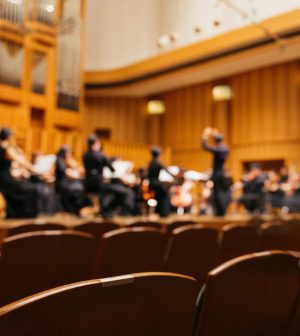
New research suggests that concert goers may synchronize their breathing and more as they listen to the intricacies of a classical symphony performance.
Previous studies have shown that music may be able to induce synchronization in listeners, but the authors of this study said there has been little investigation into whether concert audiences actually become synchronized.
This new study, involving 132 participants, suggests that heart rate, breathing rate and the electrical conductivity of skin (which suggests excitement) may synchronize between audience members at classical concerts.
People who rated more highly for personality traits such as agreeableness or openness were more likely to synchronize with other audience members. Those with neurotic or extravert traits were less likely to become synchronized.
The researchers, led by Wolfgang Tschacher, from the University Hospital of Psychiatry and Psychotherapy, in Bern, Switzerland, observed the 132 people while they listened to a concert in which three classical music pieces were played by a string quintet. They were Ludwig van Beethoven’s “Op. 104 in C minor,” Brett Dean’s “Epitaphs,” and Johannes Brahms’ “Op. 111 in G major.”
The research team monitored participants’ movement using overhead cameras and measured their physical responses with wearable sensors.
They also asked the participants to fill in questionnaires about their personality and mood both before and after the concert.
While the investigators saw synchronization in a variety of measures, the greatest level of synchronization was seen in the breathing rate.
The findings were published online Oct. 5 in the journal Scientific Reports.
A study limitation is there were gaps in data collection due to prioritizing wearer comfort over data quality when choosing sensors. More reliable data collection methods should be developed for future studies, the study authors noted in a journal news release.
More information
The U.S. National Center for Complementary and Integrative Health has more on music and health.
SOURCE: Scientific Reports, news release, Oct. 5, 2023
Source: HealthDay
Copyright © 2026 HealthDay. All rights reserved.
Related
-
 Navigating Your Midlife Crisis: Embracing New Possibilities
A midlife crisis can open doors to personal growth...
- December 4, 2025
-
 Want A Happier Hospital? Hire More Nurses, Study Says
Adding even a few extra nurses can dramatically reduce...
- November 20, 2025
-
 Plasma Treatment Shows Promise For Menopause Symptoms Among Breast Cancer Survivors
Plasma infusions may help breast cancer survivors avoid genital...
- November 20, 2025
-
 Self-Hypnosis Can Thwart Hot Flashes
Self-hypnosis might help some women in menopause find relief...
- November 14, 2025






