
- How Blue Light Impacts Your Sleep Quality
- Comparing Whey and Plant-Based Protein: Which is Best?
- How Long Does Nicotine Remain in Your System?
- The Best Time of Day to Drink Bone Broth to Maximize Health Benefits
- 8 Ways to Increase Dopamine Naturally
- 7 Best Breads for Maintaining Stable Blood Sugar
- Gelatin vs. Collagen: Which is Best for Skin, Nails, and Joints?
- The Long-Term Effects of Daily Turmeric Supplements on Liver Health
- Could Your Grocery Store Meat Be Causing Recurring UTIs?
- Are You Making This Expensive Thermostat Error This Winter?
Disinfectants Can’t Defeat Salmonella in Food-Processing Plants: Study

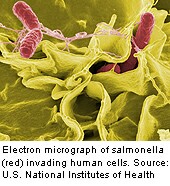
Once salmonella finds its way into a food-processing plant, the bacteria can be extremely hard to eliminate, a new study finds.
Researchers used three types of disinfectants to try to kill a build-up of salmonella bacteria — known as a biofilm — that had formed on a variety of hard surfaces. The study was published online and in the February print issue of the journal Applied and Environmental Microbiology.
“We found that it was not possible to kill the salmonella cells using any of the three disinfectants if the biofilm was allowed to grow for seven days before the disinfectant was applied,” researcher Mary Corcoran, of National University Ireland, said in a journal news release.
The biofilms survived even after the researchers soaked them in disinfectant for 90 minutes.
“We found that all of the types of salmonella we looked at were able to adopt the specialized biofilm lifestyle on all of the surfaces we looked at, including glass, stainless steel, glazed tile and plastic,” Corcoran said. “The biofilm of salmonella gets more dense over time, and becomes more firmly attached to the surface.”
Corcoran said the findings show that food-processing facilities must keep salmonella out of clean areas where cooked foods are further processed and packaged.
“People need to question whether disinfectants that are promoted as killing various types of bacteria are really as effective in real-life situations where biofilms can form as they are claimed to be based on experiments that do not use biofilms,” she said. “A lot of the time, the disinfectant may add very little, if anything, to good cleaning and appropriate food-handling practices.”
Further research is needed to find better ways to kill salmonella biofilms, Corcoran said.
Each year in the United States, there are more than 1 million cases of salmonella infection that result in 23,000 hospitalizations and 450 deaths, according to the U.S. Centers for Disease Control and Prevention.
More information
The U.S. Centers for Disease Control and Prevention offers salmonella prevention tips.
Source: HealthDay
Copyright © 2026 HealthDay. All rights reserved.
Related
-
 Navigating Your Midlife Crisis: Embracing New Possibilities
A midlife crisis can open doors to personal growth...
- December 4, 2025
-
 Want A Happier Hospital? Hire More Nurses, Study Says
Adding even a few extra nurses can dramatically reduce...
- November 20, 2025
-
 Plasma Treatment Shows Promise For Menopause Symptoms Among Breast Cancer Survivors
Plasma infusions may help breast cancer survivors avoid genital...
- November 20, 2025
-
 Self-Hypnosis Can Thwart Hot Flashes
Self-hypnosis might help some women in menopause find relief...
- November 14, 2025






