
- How Blue Light Impacts Your Sleep Quality
- Comparing Whey and Plant-Based Protein: Which is Best?
- How Long Does Nicotine Remain in Your System?
- The Best Time of Day to Drink Bone Broth to Maximize Health Benefits
- 8 Ways to Increase Dopamine Naturally
- 7 Best Breads for Maintaining Stable Blood Sugar
- Gelatin vs. Collagen: Which is Best for Skin, Nails, and Joints?
- The Long-Term Effects of Daily Turmeric Supplements on Liver Health
- Could Your Grocery Store Meat Be Causing Recurring UTIs?
- Are You Making This Expensive Thermostat Error This Winter?
Hair Salon Talk Can Spread COVID, But Face Shields Cut the Danger
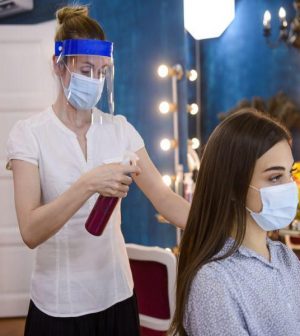
Just having a chat in a hair salon can spread the coronavirus that causes COVID-19, a new study finds.
The same is likely true in many health care settings, the same research showed.
Most research on exhaled air and the spread of the virus has focused on coughing or sneezing, which can spread small respiratory droplets across long distances.
For this study published online Feb. 23 in the journal Physics of Fluids, Japanese researchers assessed the movement of exhaled air from hair salon workers while talking. They simulated a number of typical scenarios, such as workers standing and leaning over customers, or shampooing a reclining customer.
“A significant amount of similar face-to-face contact would occur not only in cosmetology but also in long-term and medical care,” said study author Keiko Ishii, from the department of mechanical engineering at Aoyama Gakuin University in Tokyo.
“We analyzed the characteristics of exhalation diffusion with and without a mask when a person was standing, sitting, facing down, or lying face up,” Ishii explained in a journal news release.
The researchers found that exhaled air from an unmasked hair salon worker who is speaking tends to move downward due to gravity, which means that a customer below the talking worker could be at risk of infection.
When a talking worker wears a mask while standing or sitting, the aerosol cloud tends to attach to the speaker’s body, which is warmer than the surrounding air, and flows upward along the body.
But if a worker is leaning over, the aerosol cloud is likely to detach from that person’s body and drift onto the customer below, according to the study.
Experiments with face shields found they can prevent aerosols that leak from around the talking worker’s mask from floating down to the customer.
“The face shield promoted the rise of the exhaled breath,” said Ishii. “Hence, it is more effective to wear both a mask and a face shield when providing services to customers.”
More information
The U.S. Centers for Disease Control and Prevention has more on COVID-19 prevention.
SOURCE: Physics of Fluids, news release, Feb. 23, 2021
Source: HealthDay
Copyright © 2026 HealthDay. All rights reserved.
Related
-
 Navigating Your Midlife Crisis: Embracing New Possibilities
A midlife crisis can open doors to personal growth...
- December 4, 2025
-
 Want A Happier Hospital? Hire More Nurses, Study Says
Adding even a few extra nurses can dramatically reduce...
- November 20, 2025
-
 Plasma Treatment Shows Promise For Menopause Symptoms Among Breast Cancer Survivors
Plasma infusions may help breast cancer survivors avoid genital...
- November 20, 2025
-
 Self-Hypnosis Can Thwart Hot Flashes
Self-hypnosis might help some women in menopause find relief...
- November 14, 2025






