
- How Blue Light Impacts Your Sleep Quality
- Comparing Whey and Plant-Based Protein: Which is Best?
- How Long Does Nicotine Remain in Your System?
- The Best Time of Day to Drink Bone Broth to Maximize Health Benefits
- 8 Ways to Increase Dopamine Naturally
- 7 Best Breads for Maintaining Stable Blood Sugar
- Gelatin vs. Collagen: Which is Best for Skin, Nails, and Joints?
- The Long-Term Effects of Daily Turmeric Supplements on Liver Health
- Could Your Grocery Store Meat Be Causing Recurring UTIs?
- Are You Making This Expensive Thermostat Error This Winter?
Another Reason Why Cats Go Wild for Catnip
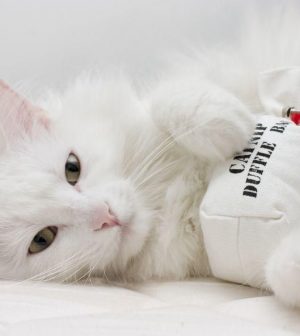
You may think that cats crave the plants catnip and silver vine because it makes them feel euphoric, and that’s true.
Yet new research indicates felines also use the plants for another key reason: to keep mosquitoes at bay.
Silver vine, a catnip alternative, grows in China and Japan. Researchers began by identifying that one active ingredient in both plants, called nepetalactol, most strongly triggers ‘catnip crazed’ cat behavior. They confirmed the reaction in 35 small cats as well as three large undomesticated breeds — jaguar, Amur leopard and Eurasian lynx.
Knowing that nepetalactol may repel mosquitoes, they then hypothesized that cats’ response to the plants allows them to transfer the compound to their fur for mosquito protection.
To determine whether this was purposeful, researchers placed paper filters with nepetalactol on different parts of a cat cage.
When cats rubbed against the nepetalactol paper, the substance was transferred to their faces and heads. This indicated that the most important function of rubbing behavior is to apply the chemical to these parts of feline fur, researchers said.
“Next, we tested the mosquito repellent property of nepetalactol on cats. We counted the numbers of mosquitoes landing on cat heads with and without application of nepetalactol. The mosquitoes landed less on the nepetalactol heads,” said study leader Masao Miyazaki, a professor at Iwate University in Japan.
To see whether mosquitoes react the same in a more natural setting, we compared the mosquito reaction between cats that responded to silver vine leaves and non-responsive cats,” Miyazaki said.
“Mosquitoes avoided the responsive cats. From these results, we found that the cats’ reaction to silver vine is chemical defense against mosquitoes, and perhaps against viruses and parasitic insects. This was the most significant finding of our study,” he said in a university news release.
Miyazaki and his colleagues see many possibilities for using the findings in research.
“Why is this reaction limited to cats? Why don’t non-feline animals react to the plant? To find answers, we want to identify the gene responsible for the reaction. The findings of this study may be used in various applications, including development of new mosquito-repellent products,” Miyazaki said.
The research was published Jan. 20 in Science Advances.
More information
The Humane Society of the United States has more on cats’ love for catnip.
SOURCE: Iwate University, news release, Jan. 20, 2021
Source: HealthDay
Copyright © 2026 HealthDay. All rights reserved.
Related
-
 Navigating Your Midlife Crisis: Embracing New Possibilities
A midlife crisis can open doors to personal growth...
- December 4, 2025
-
 Want A Happier Hospital? Hire More Nurses, Study Says
Adding even a few extra nurses can dramatically reduce...
- November 20, 2025
-
 Plasma Treatment Shows Promise For Menopause Symptoms Among Breast Cancer Survivors
Plasma infusions may help breast cancer survivors avoid genital...
- November 20, 2025
-
 Self-Hypnosis Can Thwart Hot Flashes
Self-hypnosis might help some women in menopause find relief...
- November 14, 2025






